
Table of Contents
- What Is a Split AC
- What Is a Cassette AC
- Cooling Performance: Airflow and Coverage
- What Each One Actually Requires
- Appearance and Space Usage
- Noise Levels
- Price and Long-Term Cost
- What Ongoing Care Looks Like
- Energy Efficiency
- Quick Comparison
- Which One Should You Choose
- Before You Buy
Split AC vs Cassette AC is one of the most common questions people ask when the heat and humidity rise together. Walk into any electronics showroom, and you will see rows of options. But most buyers eventually narrow it down to two main types: Split AC and Cassette AC. Both are designed to cool a space. However, they are built differently, they install differently, and they suit different kinds of rooms. This guide breaks down every major difference in the Split AC vs Cassette AC debate, so you can decide with confidence — the same way we broke down features and pricing in our smartphone comparison guide.
What Is a Split AC
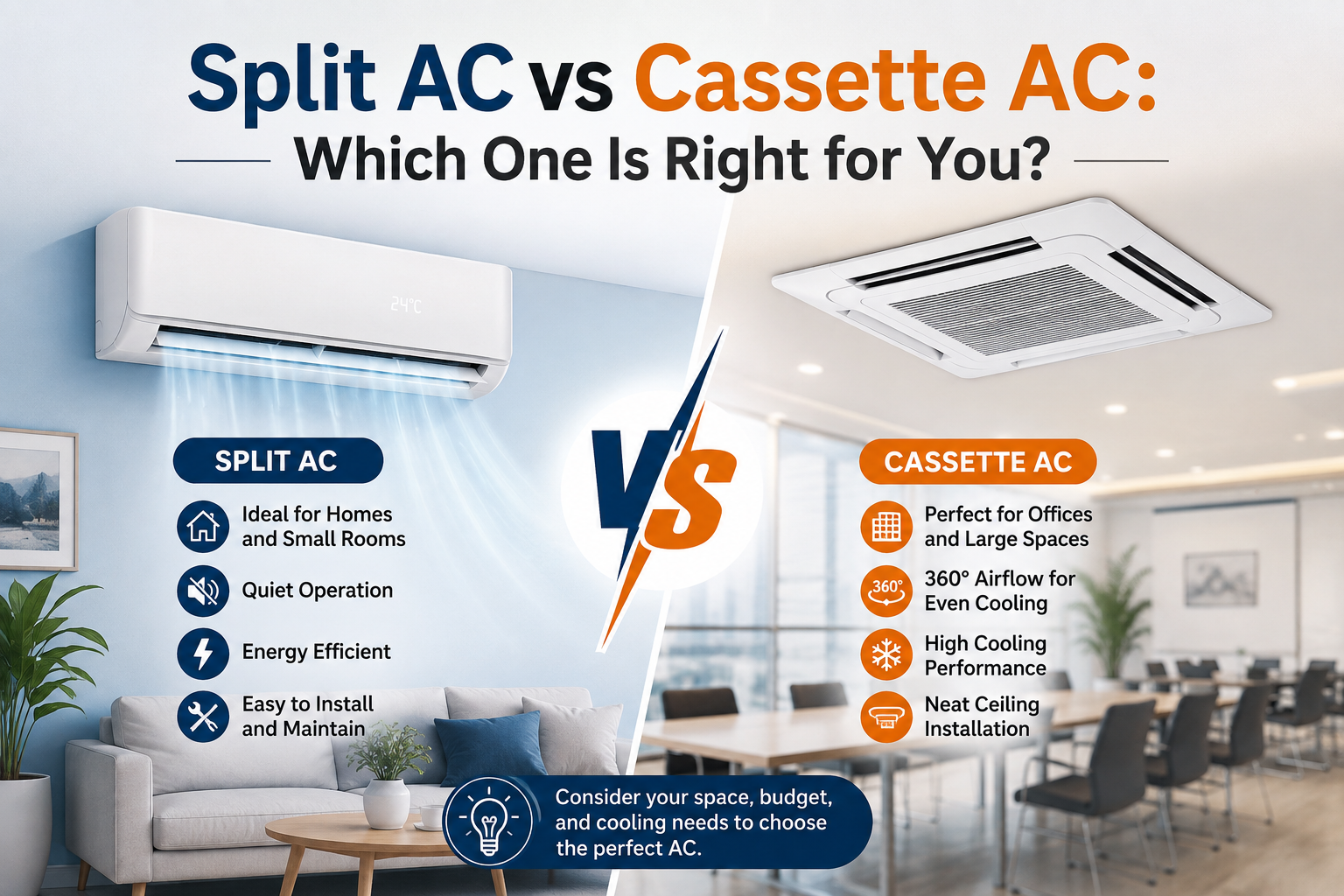
We commonly see a Split AC on the walls of bedrooms. It has two modules. One is installed on the room wall and is called the indoor unit. The other is fitted outside a building, on a balcony, window, or wall, and is called the outdoor unit. Air travels from one unit to the other through a refrigerant line and a drain pipe. This process delivers cool air into the room and removes heat outside.
Because it is the most common form of AC, this appliance does not take up much space, since it stays fitted on the wall. It works well for living rooms, bedrooms, single office cabins, and shops. Installation is straightforward. A technician can usually finish it within a day, since no structural change to the wall is needed.
What Is a Cassette AC
A Cassette AC takes a completely different approach in the Split AC vs Cassette AC comparison. Instead of sitting on a wall, its indoor unit is recessed into the ceiling. It fits flush with a false ceiling panel. From below, you mostly see a flat grille with vents on all four sides.
This 4-way airflow design is the key feature. Cool air pushes outward in every direction at once, rather than in a single stream. As a result, the unit cools a much larger and more irregularly shaped room evenly, without leaving hot corners far from the unit. You will find Cassette ACs in offices, showrooms, restaurants, hotel lobbies, and hospital waiting areas. Any large open floor that needs consistent cooling is a good fit.
Cooling Performance: Airflow and Coverage

This is where the Split AC vs Cassette AC comparison matters most.
A Split AC blows air in one direction, usually straight out from the wall unit. In a small or medium bedroom, this is not a problem. The air circulates naturally within a few minutes. But in a large open room, the side closest to the unit cools fast, while the far side lags behind. The room never quite feels evenly cooled unless you also run ceiling fans to help push the air around.
A Cassette AC solves this by distributing air from all four sides of the ceiling unit at the same time. In a large hall, conference room, or open-plan office, this 360-degree spread means every seat feels roughly the same temperature. This is also why one well-placed Cassette AC can sometimes do the job of two or three Split ACs in the same space.
What Each One Actually Requires
Split AC installation is simple. A technician can make a small hole in the wall for the pipes, fix the indoor unit on brackets, place the outdoor unit outside, and connect them. Generally, installation takes about half a day. There is no construction work involved, so you can add a Split AC to almost any room.
Cassette AC installation is more complex. It requires a false ceiling, since the unit, its drain pan, and its piping all sit above the ceiling line. So if you are renovating or building a new office, shop, restaurant, or showroom, you should plan the false ceiling and the AC placement together from the start. Retrofitting a Cassette AC into a room without a false ceiling means extra construction work first. This is why you typically see Cassette ACs in newly built or refurbished commercial spaces, rather than in older homes.
Appearance and Space Usage
A Split AC’s indoor unit stays visible on the wall. Depending on the room layout, it can take up usable wall space or clash with your interior design. The outdoor unit also needs an external mounting spot, and that is not always available in every building.
A Cassette AC disappears into the ceiling, leaving the walls and floor completely free. For businesses that care about how a space looks, such as showrooms, restaurants, or corporate offices, this cleaner and more discreet look is a real advantage. It also means your furniture layout is not restricted by where the AC unit happens to sit.
Noise Levels
Noise is another factor in the Split AC vs Cassette AC decision, and it matters more than people expect, especially in offices or restaurants where a humming AC can be distracting. Split ACs, particularly older or non-inverter models, tend to be a bit louder, since the compressor cycles on and off more often. Cassette ACs, especially inverter models, generally run quieter at the point of use, since the unit sits above head height and spreads airflow across a wide grille instead of one spot. Inverter technology, in either a Split AC or a Cassette AC, reduces noise further by keeping the compressor running at a steady, lower speed instead of switching on and off constantly.
Price and Long-Term Cost
Split ACs are generally the more affordable option upfront, both in unit price and installation cost. For a single bedroom or small office, this makes them the practical default choice.
Cassette ACs cost more per unit and cost more to install, mainly because of the false ceiling requirement and the more complex piping work. However, the Split AC vs Cassette AC math changes for large spaces.
Covering a big hall with several Split ACs means several outdoor units, several points of failure, and several maintenance schedules. One 2 to 3 ton Cassette AC can often replace two or three Split ACs. Over time, that can make it the more economical choice, not just in equipment cost, but also in electricity efficiency and servicing effort.
What Ongoing Care Looks Like
Split AC maintenance is simple. Clean or replace the air filter every month or two. Then get a professional service check once or twice a year to clean the coils and check refrigerant levels.
Cassette AC maintenance has one extra step: the drain pipe. Because the unit sits inside the ceiling, any blockage in the drain line can lead to water leaking down through the ceiling panel. This is a problem you will not face with a wall-mounted Split AC. Regular drain checks, filter cleaning, and at least two professional servicing visits a year help you avoid this issue.
Energy Efficiency
Both types come in inverter and non-inverter versions. Regardless of the type, inverter technology matters more for your electricity bill than whether the unit is wall-mounted or ceiling-mounted.
An inverter compressor runs at variable speed. Instead of starting at full strength and then shutting off completely, it runs as hard or as soft as needed to hold the room temperature steady. This makes a noticeable difference in power usage over a full season.
When comparing a Split AC and a Cassette AC of the same tonnage, check the inverter version first. In this part of the Split AC vs Cassette AC decision, inverter technology usually has a bigger impact on your bill than the mounting style.
Quick Comparison
Here is a side-by-side Split AC vs Cassette AC summary to help you compare at a glance.
| Factor | Split AC | Cassette AC |
|---|---|---|
| Best for | Bedrooms, small rooms, small offices | Large offices, halls, showrooms, restaurants |
| Airflow | One direction | Four directions (360°) |
| Installation | Simple, no false ceiling needed | Requires false ceiling |
| Appearance | Visible wall unit | Hidden in ceiling |
| Typical price | Lower | Higher |
| Maintenance | Filter cleaning, basic servicing | Filter cleaning + drain pipe checks |
| Ideal room size | Up to ~150-200 sq ft | 300 sq ft and above |
Which One Should You Choose
The Split AC vs Cassette AC choice usually comes down to room size and layout. If your space is a small bedroom, a drawing room, or an office cabin, a Split AC meets your needs at a lower cost and is much easier to install. In most cases, there is little reason to choose a Cassette AC for a space this size.
On the other hand, if you need to cool a big office floor, a conference hall, a commercial display area, or a restaurant dining area, a Cassette AC is usually the better fit. These are open spaces that already have, or can have, a false ceiling, which is a requirement for installing a Cassette AC. It costs a bit more, but it delivers better, even cooling and a neat installation.
Before You Buy
No matter which type you choose in the Split AC vs Cassette AC decision, make sure the tonnage matches your room size. An undersized unit will run constantly and wear out faster. An oversized one cools the air quickly without properly removing moisture from the room.
Choose an inverter model if your budget allows, since the electricity savings add up over the years. Review the brand’s warranty terms and after-sales service before you finalize your purchase, since AC servicing is an ongoing cost, not a one-time expense — the same careful checklist approach we recommend in our pre-purchase checking guide.
If you want to compare models, prices, and warranty details from multiple brands in one place, you can browse the current lineup at Ryans.
In short, when it comes to Split AC vs Cassette AC, a Split AC does the job well for small, everyday spaces and costs less. For large commercial spaces that need even, reliable cooling across an open floor, a Cassette AC is the smarter long-term investment.








Leave a Comment